

Cursor is reportedly on a $2 billion annual revenue run rate, yet a vocal cohort of its core user base—engineers—are publicly declaring it obsolete. This isn't a simple story of a hot startup facing competition. It's a signal of a fundamental paradigm shift in software development, a shift from "AI-assisted coding" to "autonomous agent execution."
Understanding this paradox is crucial for anyone building or buying enterprise AI. It reveals where the true value and defensible moats will be in the next era of software engineering.
The Financial Paradox: Enterprise Inertia vs. Developer Velocity
The disconnect between Cursor's reported financials and developer sentiment is jarring. On one hand, reports claim a valuation approaching $30 billion, with revenue doubling from $1B to $2B in just three months. The driver? Enterprise contracts. Large organizations, having navigated lengthy procurement, legal, and security reviews to approve a tool, do not switch on a dime. Annual contracts, SSO and RBAC integration, and compliance guarantees create immense inertia. For a CIO at a large financial institution, Cursor is a vetted, stable choice.
On the other hand, in the fast-moving world of startups and elite developers, the narrative is entirely different. On X, you'll find CTOs stating their teams have completely churned off Cursor. The sentiment is that "only grandpas use Cursor," as newer, more powerful tools have emerged. Mortgage startup Valon reportedly cancelled over 90 subscriptions, finding that autonomous agents could automate entire workflows end-to-end at a "10x" speed improvement.
This isn't just cognitive dissonance; it's a leading indicator. The enterprise market is a lagging one. The trends being set today by the most advanced developers will become enterprise best practices in 12-18 months. And that trend is a seismic shift away from the IDE.
The Agentic Shift: Why Your IDE is Becoming Obsolete
For the last two years, the dominant paradigm has been AI-assisted coding. The developer remains the central actor, with AI acting as an incredibly powerful autocomplete and pair programmer inside a familiar IDE. GitHub Copilot pioneered this, and Cursor perfected the user experience.
That era is ending.
The latest frontier models from Anthropic and OpenAI have crossed a critical threshold in reasoning and coding ability. They don't just complete lines; they comprehend and execute complex, multi-step tasks. This has given rise to the new paradigm: autonomous agents.
The workflow is no longer human-centric. The developer now acts as an orchestrator, providing high-level goals to an agent that operates autonomously. The primary interface for this is not a GUI-heavy IDE, but the command-line interface (CLI).
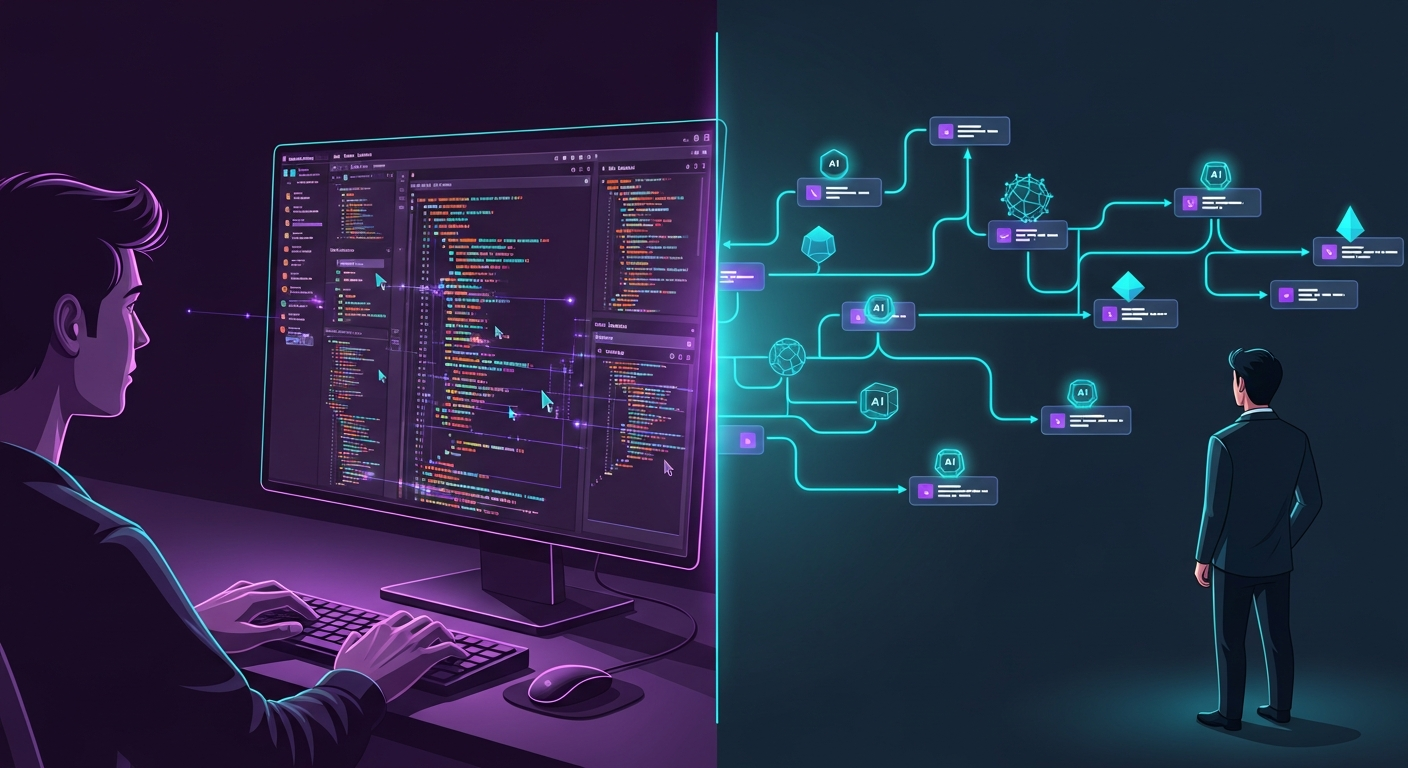
This shift explains the mass exodus of power users from Cursor. They aren't just leaving for a competitor; they are abandoning the entire product category. Veteran engineers describe a regression in Cursor's own product:
- Performance Bloat: What was once a lightweight VS Code fork has become a resource hog, with multiple Chromium processes slowing down development machines.
- UI Clutter: The forced introduction of agent windows and constant UI changes disrupted established muscle memory, adding friction instead of removing it.
- Broken Trust: An abrupt change from a generous subscription model to an expensive, per-call API pricing model alienated many early adopters. The destination for these developers? A return to first principles. They are embracing minimalist, high-performance setups like Neovim + Tmux and interfacing directly with powerful CLI-native agents like Claude Code and OpenAI's Codex. The logic is simple: if the agent is doing the heavy lifting in the terminal, why encumber it with a bloated editor? The lean editor should live inside the agent's environment, not the other way around.
Cursor's Wrenching Pivot: From Wrapper to Competitor
To their credit, Cursor's leadership understands this existential threat. Their internal priority is now chillingly direct: "P0 #1: Build the best coding model." They are attempting a difficult and costly pivot from being a sophisticated UI/UX wrapper to a full-stack agent and model provider, putting them in direct competition with their former partners, Anthropic and OpenAI.
Their survival strategy is multifaceted:
- Go Enterprise: Double down on the slower-moving, stickier enterprise segment where inertia is a defensive moat. This is a GTM pivot, with half their staff reportedly now focused on sales and marketing.
- Build a Data Moat: Leverage their vast repository of user interaction data to train proprietary models that are smaller, faster, and more specialized.
- Reduce Foundation Model Dependency: They are developing their own proprietary "Composer" models, which are reportedly fine-tuned versions of powerful open-source models like DeepSeek and Qwen. This is a high-stakes bet. They are now competing against the very companies that are willing to heavily subsidize their own coding agents to win market share. One analysis suggested a $200/month Claude Code subscription could be costing Anthropic as much as $5,000 in monthly compute—a loss-leader strategy Cursor cannot afford to match long-term, especially on its consumer plans.
The Epsilla Perspective: The Future is Headless Infrastructure
Cursor's struggle is the perfect validation of our thesis at Epsilla. The future of AI-powered software development is not a better, more feature-packed IDE. Cramming agentic capabilities into a graphical editor is a transitional phase, an awkward bridge between two paradigms.
The future is invisible, autonomous, and API-first.
Developers will orchestrate swarms of specialized agents that execute complex tasks in the background. These agents will be headless and CLI-native, managed and monitored through APIs. The IDE, if it exists at all, will be just one of many thin clients—a simple viewport into the agent's work, not the central workbench.
This is precisely why we are building Epsilla as an "Agent-as-a-Service" platform. The real challenge for enterprises is not building a better UI for code generation. The critical, unsolved problem is the infrastructure required to build, deploy, and manage these autonomous agents at scale.
This includes:
- Stateful Memory: Providing agents with reliable, long-term memory to handle complex, multi-day tasks.
- Tool Orchestration: Securely giving agents access to APIs, databases, and other internal systems.
- Observability and Control: Creating the necessary logging, monitoring, and governance frameworks for fleets of autonomous agents operating on critical infrastructure. The agentic shift is real, and it is accelerating. Companies that understand that the true value lies in the agentic backend—the infrastructure that enables autonomy—are the ones that will build lasting value. The focus must shift from the editor to the engine. At Epsilla, we are building that engine for the enterprise.