
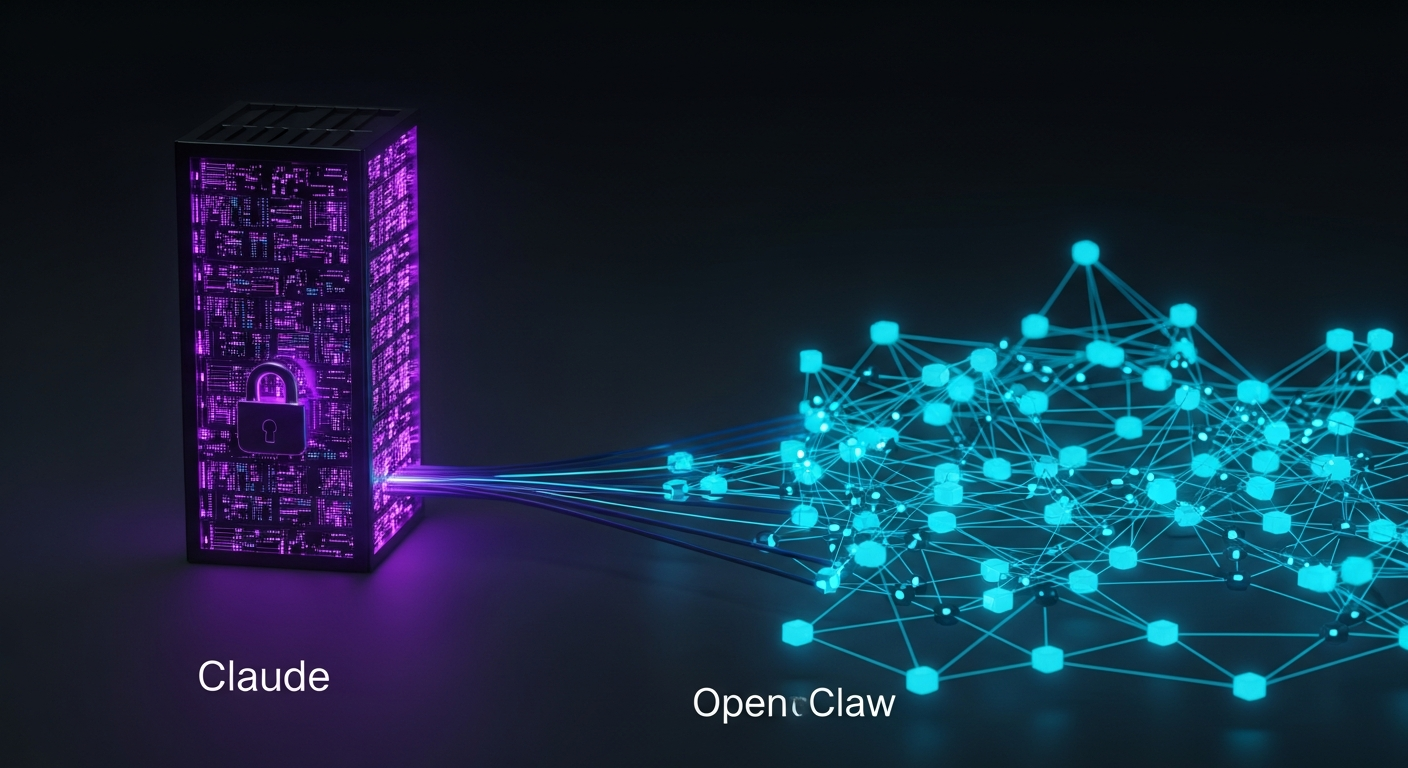
A recent update to Claude Code, v2.1.71, introduced a seemingly minor feature: /loop. It allows a user to run a task on a recurring basis with a single command. To anyone following the agentic AI space, the parallel was immediate and unmistakable. This was Anthropic's polished, user-friendly version of a core capability in the open-source project OpenClaw.
This wasn't an isolated incident. Over the past quarter, Anthropic has systematically rolled out features that mirror the foundational pillars of OpenClaw: Cowork for local file access, recurring tasks for scheduled actions, and Memory for persistent context.
Features can be copied. Ecosystems cannot.
Anthropic is clearly reacting to validated demand from the open-source frontier. The pattern is a familiar one in tech: a major player observes a breakout open-source project, identifies the core user needs it has validated, and productizes them for a mass-market audience.
The critical question is not whether Claude can replicate OpenClaw's feature list—it largely can, and often with a better user experience. The question is whether it can replicate its essence. The analysis suggests it cannot, and the reason reveals a fundamental schism in the future of agentic AI.
Claude’s Path: The Institutionalization of Agents
Anthropic’s strategy is clear: build a secure, compliant, and deeply integrated enterprise AI platform. Every new feature, from the sandboxed Cowork environment to partner-vetted Skills, is designed to meet the stringent requirements of corporate customers.
Cowork: Grants Claude access to your local file system, but within a controlled, virtualized environment. It's powerful, but with clear boundaries.- Recurring Tasks &
/loop: Automate workflows, but based on user-defined schedules. The user sets the alarm clock; the agent does not decide when to wake up. - Memory & Skills: Provide persistence and extensibility, but the memory resides on Anthropic's servers, and the skills are curated through a partnership model. This is the path of institutionalization. It prioritizes security, reliability, and ease of use. For a company serving large enterprises, whose revenue is overwhelmingly tied to enterprise contracts demanding admin controls, audit logs, and compliance, this is the only logical path.
OpenClaw’s Path: Permissionless Innovation
OpenClaw represents the diametrically opposite philosophy. It is a decentralized, open, and at times chaotic ecosystem that prioritizes user control and extensibility above all else.
This divergence is most visible in the "App Store vs. Skill Store" paradigm. OpenAI’s GPT Store stagnated under the weight of its own review process. Claude’s partner-driven Skill directory is high-quality but grows at a glacial pace.
Meanwhile, the community-driven ClawHub exploded from under 3,000 to over 17,000 skills in a matter of weeks. The barrier to entry is effectively zero: a GitHub account is all you need. This has unleashed a torrent of long-tail innovation—skills for booking sports courts, managing niche DeFi protocols, or automating personal habits—that would never survive a corporate approval process.
This permissionless model comes at a cost. Security is a significant concern, with malicious skills being a documented reality. But this is the classic trade-off: chaos and vitality are two sides of the same coin. The early days of the App Store or DeFi were similarly fraught with risk, yet that primordial chaos was the necessary substrate for the robust ecosystems that followed.
An enterprise AI company like Anthropic cannot afford this trade-off. Their business model requires them to choose security and order.
The Core Contradiction: Data Sovereignty vs. The SaaS Business Model
This brings us to the core, irreconcilable conflict. The business model of an enterprise AI SaaS platform is fundamentally at odds with the principle of true data sovereignty.
Enterprises pay for control, analytics, and compliance. These features—admin dashboards, usage analytics, audit logs—all presuppose that the platform has access to user data. If Anthropic were to build a system where user memory, preferences, and data were entirely local and encrypted—invisible to them—they would be unable to provide the very services that 80% of their revenue depends on.
- Memory: Claude's Memory is a feature hosted on their servers. OpenClaw's memory is a folder of Markdown files on your local machine, version-controlled with Git.
- Autonomy: Claude's
/loopis a user-initiated cron job. OpenClaw'sheartbeatis designed to give the agent a "biological clock," enabling a degree of self-initiated action. For a company navigating the political sensitivities of AI safety, true agent autonomy is a line they are unlikely to cross. - Model Lock-in: Claude, naturally, only uses Claude models. OpenClaw is model-agnostic, able to orchestrate Claude, GPT-5, Gemini, and open-source models simultaneously. The more successful Anthropic becomes as an enterprise SaaS provider, the more it must reinforce its walled garden. It's a structural necessity. OpenClaw thrives precisely because it has no such commercial constraints.
The Epsilla Perspective: A Third Way for the Enterprise
As founders and CTOs, we are caught in this divergence. We need the explosive innovation and flexibility of the open ecosystem, but we require the security, control, and compliance of an enterprise platform. The choice is not between the "Wild West" of OpenClaw and the "Walled Garden" of Claude. The choice is to find a third way.
This is the strategic ground upon which Epsilla is built.
If OpenClaw is the framework for hackers and Claude is the locked-in SaaS application, Epsilla is the enterprise-grade orchestration layer that offers the best of both worlds.
We recognize that the future of enterprise AI is not a single, monolithic agent. It is a fleet of sovereign agents, specialized for specific tasks, that you own and control. Our platform is designed to make this a reality.
- Model Agnostic by Design: Epsilla's orchestration layer is API-agnostic. You can build agents that leverage the reasoning power of Claude for one task, the speed of a fine-tuned open-source model for another, and the specific capabilities of GPT-5 for a third. We eliminate vendor lock-in at the most critical layer of the stack.
- Sovereignty with Security: We provide the tools to build agents that connect to your proprietary data and internal systems without surrendering control. With Epsilla, you get the robust access controls, audit logs, and security posture that an enterprise requires, but you apply them to an open, flexible agent architecture. Your agent's "memory" can be your own vector database, its "skills" your own internal APIs.
- Bridging the Gap: The technical barrier to entry for frameworks like OpenClaw is steep, and their security model is untenable for corporate use. Epsilla provides the managed infrastructure, developer tooling, and security framework that allows your teams to move from concept to production with sovereign AI agents, securely and at scale. Claude is building a better, safer car. OpenClaw is shipping engine parts to everyone. At Epsilla, we're building the automated factory that lets you design and deploy your own custom fleet of vehicles, using the best engine for each one, with the assurance that you own the blueprints and control the assembly line. The divergence between centralized platforms and open ecosystems is not a battle to be won by one side. It is the defining tension that creates the opportunity for a more sophisticated, sovereign approach to enterprise AI.